
Why Waterfront Storm Damage Clean Up in Anderson County TX Demands Immediate Attention
When a severe thunderstorm, hurricane remnant, or tornado rips through Anderson County TX, the damage doesn’t stop at your roofline. For those of us who own lakefront property, a private pond, or any waterfront acreage in East Texas, the real devastation often hides along the shoreline, beneath the water surface, and across the fragile ecosystems we’ve worked so hard to maintain. We’ve seen firsthand how a single night of violent weather can undo years of careful pond management. Fallen trees choke waterways, storm surge reshapes banks overnight, and flash flooding deposits layers of sediment that suffocate aquatic life. The truth is, waterfront storm damage clean up is not a project you can postpone. Every hour of delay compounds the destruction—and the cost. At Arrowhead Pond Restoration, we’ve spent years helping East Texas waterfront properties recover from exactly these scenarios, and we want to share the secrets that save homeowners thousands of dollars and months of frustration.
The Hidden Dangers Lurking After a Storm Hits Your Waterfront
Most homeowners focus on structural damage to their home after severe weather, and rightly so. But if you own waterfront property in Anderson County TX, the hazards extending from your back door to the water’s edge can be just as costly and far more dangerous than they appear at first glance.
Flooded Shoreline Hazards and Submerged Debris
After heavy rainfall and flash flooding, water levels can rise dramatically along ponds, lakes, and creeks throughout East Texas. That rise carries with it flooded shoreline hazards that are easy to overlook. Submerged fence wire, displaced dock sections, shattered glass, and jagged metal from outbuildings can lurk just below the surface. We’ve pulled everything from entire carport panels to propane tanks out of clients’ ponds following major storms. Storm debris in water doesn’t just threaten anyone who wades in—it also damages boat hulls, clogs intake pipes, and creates dangerous snag points that trap wildlife.
Fallen trees and branches removal is one of the most urgent tasks after any significant weather event. A mature oak or pine toppled by straight-line winds can weigh several tons, and when it lands partially in the water with its root ball still anchored on the bank, it creates an unstable situation that worsens with every passing day. The weight pulls at the bank, accelerating shoreline erosion, while submerged limbs begin to decay and deplete dissolved oxygen in the water column.
Storm Surge, Erosion, and Structural Threats
Even in inland East Texas, storm surge effects can occur on larger impoundments when sustained high winds push water to one end of a lake or large pond. The result is dramatic shoreline erosion on the windward bank and sudden flooding on the leeward side. We’ve documented cases in Anderson County TX where a single storm removed three to five feet of established shoreline in one night.
Dock and pier damage is another common consequence. Floating docks get lifted off their pilings, fixed piers get battered by wave action and floating debris, and electrical connections for dock lighting or boat lifts become shock hazards. Dock and pier repair should never be attempted without first confirming that all electrical circuits are de-energized and that the structure is stable enough to support your weight. Our emergency storm response team has the training and equipment to assess these situations safely before any repair work begins.
Shoreline erosion control is not just about aesthetics. When your bank erodes, you lose land—permanently. Sediment displaced into the water degrades water quality, smothers fish spawning beds, and fills in the pond basin, reducing depth and storage capacity. This is why we treat shoreline erosion control as one of the top priorities during every waterfront storm damage cleanup services engagement.
Our Step-by-Step Approach to Waterfront Storm Damage Cleanup Services
At Arrowhead Pond Restoration, we’ve refined a systematic process for waterfront storm damage cleanup services that addresses both immediate hazards and long-term recovery. Here is exactly how we approach every call we receive from homeowners across Anderson County TX and the surrounding East Texas region.
Phase One: Storm Damage Assessment and Emergency Response
The moment you contact us, our 24/7 storm response line connects you with a team member who begins gathering critical information. We ask about visible damage, water level changes, downed power lines near the water, and any chemical storage such as fuel or fertilizer that may have been compromised. This initial triage allows us to prioritize our emergency storm debris removal efforts and dispatch the right crew with the right equipment.
Our storm damage assessment begins on-site with a full perimeter survey of the affected waterfront. We document every element of destruction with photographs, GPS coordinates, and detailed notes. This documentation serves two vital purposes. First, it guides our restoration plan. Second, it provides the insurance documentation for storm damage claims that your carrier will require. We know from experience that thorough, professional documentation can mean the difference between a fully covered claim and a denied one. Insurance claims assistance is something we provide as a standard part of our waterfront storm damage cleanup services because we believe you shouldn’t have to fight your insurance company while also fighting to save your property.
Our storm damage assessment checklist includes:
– Structural integrity of docks, piers, retaining walls, and bulkheads
– Extent of shoreline erosion and bank failure
– Volume and type of storm debris in water and along the bank
– Status of aeration systems and water circulation equipment
– Evidence of stormwater runoff and pollution entering the pond or lake
– Condition of aquatic vegetation and visible impact on fish and wildlife habitat
– Identification of flooded shoreline hazards and safety risks
Phase Two: Emergency Storm Debris Removal and Hazard Mitigation
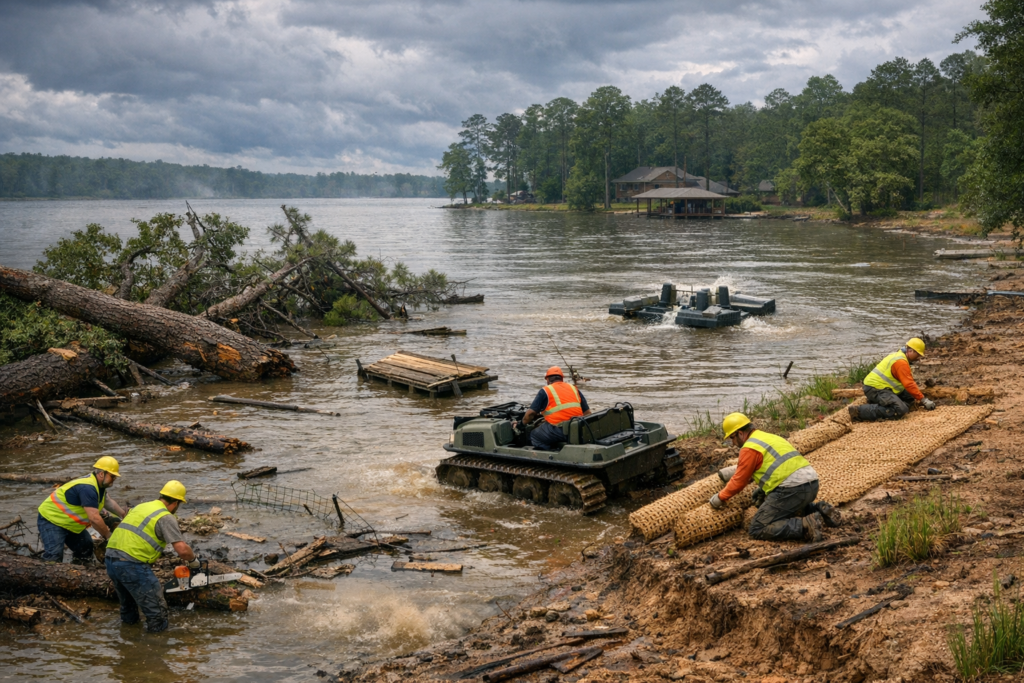
Once the assessment is complete, we move immediately into emergency storm debris removal. Our crews are equipped with commercial-grade chainsaws, excavators, skid steers, amphibious equipment, and specialized watercraft designed for extracting heavy debris from soft-bottom ponds and lakes. Fallen trees and branches removal from both the shoreline and the water itself is handled first because these items pose the greatest immediate risk to people, animals, and property.
We also address any stormwater runoff and pollution concerns during this phase. If flooding or flash flooding has carried agricultural chemicals, septic overflow, or petroleum products into your pond, we take water samples and implement containment measures immediately. Disaster restoration on waterfront properties requires a different skill set than standard land-based cleanup, and our pond and lake restoration specialists understand the unique chemistry and biology at play.
During this phase, we also coordinate with local emergency management when necessary. FEMA guidelines and county emergency management protocols sometimes apply, especially when widespread tornado damage or hurricane remnants have triggered official disaster declarations. We stay current on these guidelines so that our clients remain in compliance and eligible for any available assistance.
Restoring Your Shoreline, Ecosystem, and Peace of Mind
Emergency response is only half the battle. The real secret that homeowners wish they knew sooner is that what you do in the weeks and months following a storm determines whether your waterfront property fully recovers or slowly declines.
Shoreline Storm Damage Repair and Erosion Prevention
Shoreline storm damage repair is where our expertise truly sets us apart. After removing debris and stabilizing immediate hazards, we evaluate the best long-term solution for your specific bank conditions. Options include:
– Shoreline erosion control matting combined with native vegetation plantings to stabilize soil biologically
– Riprap installation along high-energy banks where wave action or current is strongest
– Graded bank reshaping to reduce steep slopes that are prone to slumping
– Bioengineered solutions that combine structural reinforcement with living root systems
Shoreline restoration in East Texas requires an understanding of our unique soil types—the heavy clays and sandy loams of Anderson County TX behave very differently from soils in other parts of the state. We’ve completed hundreds of shoreline storm damage repair projects across East Texas waterfront properties and we know which methods perform best in our local conditions.
Long-term shoreline maintenance is something we strongly encourage every client to consider. A storm that hits a well-maintained, properly armored shoreline causes a fraction of the damage compared to one that strikes an unprotected bank. We offer ongoing maintenance plans that include periodic inspections, vegetation management, and minor repairs before they become major problems. This proactive approach is one of the most effective ways to protect property value after storms.
Water Quality, Habitat, and Ecosystem Recovery
Pond and lake storm restoration goes far beyond what’s visible above the waterline. Water quality testing after storms is essential because flooding and flash flooding introduce contaminants, excess nutrients, and massive sediment loads into your water body. Storm runoff and sediment can trigger algae blooms, oxygen crashes, and fish kills if left unaddressed.
Our water quality testing after storms protocol measures dissolved oxygen, pH, turbidity, nutrient levels, and the presence of harmful bacteria. Based on results, we develop a targeted restoration plan that may include:
– Repairing or replacing aeration systems and water circulation units damaged by the storm
– Beneficial bacteria treatments to accelerate the breakdown of organic debris
– Aquatic vegetation damage remediation, including replanting of desirable species and removal of invasive plants introduced by floodwaters
– Fish and wildlife habitat protection measures such as installing new structure, reestablishing spawning substrate, and creating buffer zones
Fish and wildlife habitat protection is a core value for us at Arrowhead Pond Restoration. We understand that your pond or lake is more than a landscape feature—it’s a living ecosystem and often a source of recreation, relaxation, and pride. Aquatic vegetation damage left unaddressed can cascade through the food chain, reducing forage for baitfish and ultimately impacting trophy bass and other game fish populations. Our pond and lake restoration specialists design every recovery plan with the full ecosystem in mind.
Aeration systems and water circulation are particularly vulnerable during severe storms. Lightning strikes can destroy control panels, and falling debris can crush diffuser lines or damage compressors. Restoring these systems quickly is critical because adequate dissolved oxygen is the single most important factor in preventing post-storm fish kills. We stock common replacement parts and can often have your aeration systems and water circulation back online within 24 to 48 hours of our initial visit.
Protecting Your Investment for the Next Storm
We tell every client the same thing: the best time to prepare for the next storm is the day after the last one. Lakefront property storm cleanup is reactive by nature, but the smartest homeowners use the recovery process as an opportunity to build resilience into their waterfront.
Insurance, Documentation, and Financial Protection
Insurance documentation for storm damage is one of the most overlooked aspects of waterfront property ownership. Many homeowners don’t realize that standard homeowners policies often exclude or limit coverage for shoreline structures, docks, and ecosystem damage. We help our clients understand what their policies cover, provide the professional documentation needed to support claims, and connect them with public adjusters when the situation warrants it. Insurance claims assistance from a knowledgeable restoration partner can dramatically improve your outcome and protect property value after storms.
We also recommend maintaining a pre-storm condition file. This is a collection of dated photographs, water quality reports, and property surveys that establish the baseline condition of your waterfront. When disaster strikes, having this documentation makes it far easier to prove the extent of damage and the cost of restoration. FEMA and local emergency management agencies also reference baseline conditions when determining eligibility for assistance programs, so this simple step can pay enormous dividends.
Building Long-Term Resilience with Arrowhead Pond Restoration
Arrowhead Pond Restoration has been serving Anderson County TX and the broader East Texas region with dedicated waterfront storm damage cleanup services, lakefront property storm cleanup, and comprehensive pond and lake storm restoration for years. Our 24/7 storm response capability means you’re never alone when severe weather hits. We answer the phone at 2 AM because we know that’s often when the worst storms arrive.
Our commitment extends well beyond the emergency phase. We design and implement long-term shoreline maintenance programs, install robust shoreline erosion control systems, and provide ongoing water quality testing after storms to ensure your property continues to thrive season after season. We believe every East Texas waterfront property deserves the protection and care that only experienced pond and lake restoration specialists can provide.
Whether you’re dealing with active tornado damage on your shoreline right now, recovering from last week’s severe thunderstorm, or simply wanting to fortify your property before hurricane season arrives, we’re ready to help. Shoreline restoration in East Texas is not a one-size-fits-all proposition, and neither is our approach. Every property receives a customized storm damage assessment and a restoration plan tailored to its unique conditions, goals, and budget.
Here’s what we want you to remember: waterfront storm damage clean up done right the first time saves you money, preserves your ecosystem, and lets you enjoy your property with confidence no matter what the weather brings. Don’t wait until the next storm to find out what you should have done after the last one.
If you’re ready to protect your waterfront property, recover from recent storm damage, or simply have a conversation about what proactive maintenance could look like for your pond or lake, reach out to our team today. Visit us at https://arrowheadpondresto.com/ to schedule your storm damage assessment or to connect with our 24/7 storm response team. At Arrowhead Pond Restoration, your waterfront is our priority—before, during, and after every storm.