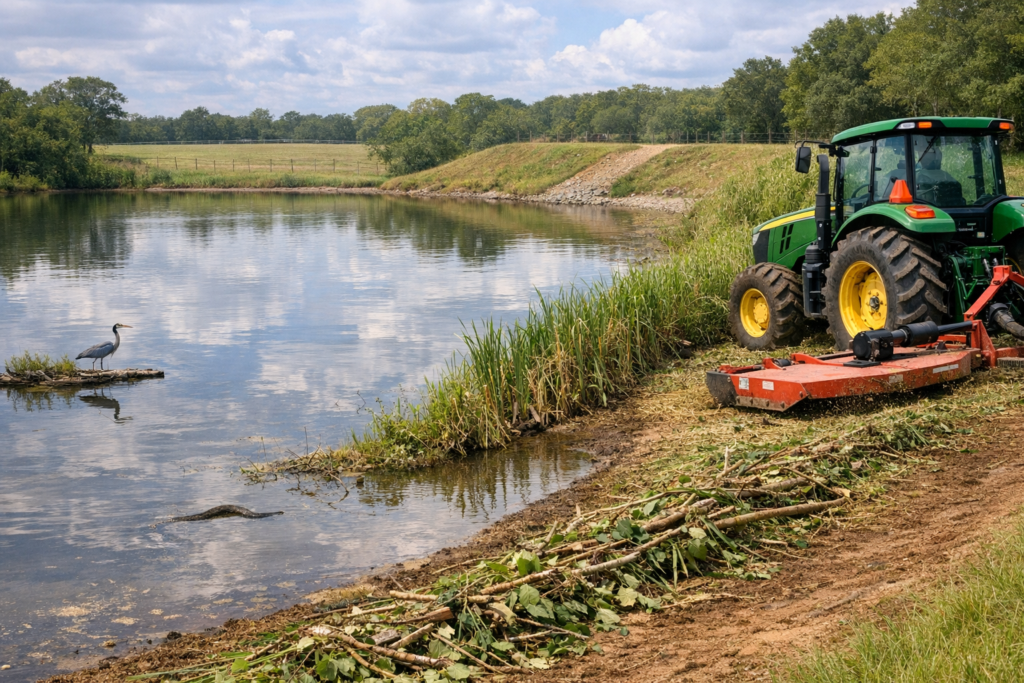
Overgrown pond edges don’t just look messy—they change how your waterbody functions. When shoreline vegetation turns into head-high briars, saplings, and mats of cattails and weeds, we’ve seen ponds in East Texas lose access, invite snakes, and trap sediment that slowly steals depth. That’s where brush hogging services come in. With the right rotary cutter and an experienced operator, we can turn overgrown land into a manageable, healthy shoreline that’s easier to fish, safer to walk, and simpler to maintain year-round. In Henderson County TX, timing and technique matter because our fast-growing brush can rebound quickly. Done correctly, pond bank clearing isn’t just “mowing”—it’s a foundational step in pond and lake management that supports long-term pond restoration and brush hogging success.
How Brush Hogging Restores Shorelines and Supports Healthier Ponds
When we talk about a brush hog, we’re talking about a heavy-duty rotary cutter designed to knock down thick grass, weeds, and woody stems that a finish mower can’t handle. A tractor brush hog is purpose-built for rough cut mowing on uneven terrain, which is exactly what most pond banks, dam slopes, and pond edges look like in real life.
What shoreline brush removal actually fixes (and why it matters)
Our experience is that shoreline brush removal improves a pond in three immediate ways: access, visibility, and control. When property owners can actually see and reach the waterline, they’re far more likely to monitor conditions and catch problems early—like muskrat burrows, eroding spots, or clogged spillways.
Overgrown shoreline vegetation also creates a “buffer” that is too thick to manage. That sounds good until it becomes a habitat for pests and a fire hazard. After brush clearing, we can spot issues that directly impact pond function, such as:
– Debris piles that redirect runoff and cut channels into the bank
– Hidden ruts that become erosion pathways during heavy rain
– Encroaching saplings that will turn into trees on a dam face (a major long-term risk)
This is why we treat brush hogging as a practical step in pond and lake management, not a cosmetic one. It’s often the first move that lets other restoration work succeed, including bank stabilization, spillway improvements, and vegetation management.
Water quality and bank stability benefits you can see
People sometimes ask if mowing can really change pond health. We’ve watched it happen. When the bank edge is choked with invasive vegetation and unmanaged brush, rainfall tends to carve narrow channels through weak spots. Those channels carry soil into the pond, increasing turbidity and sedimentation. By clearing and then maintaining a consistent bank line, we can help reduce erosion on pond banks and slow the steady loss of pond depth.
Brush hogging also helps us maintain a purposeful strip of shoreline vegetation—enough to filter runoff, but not so much that it blocks inspection and access. In practice, that balance tends to:
– Improve access to your pond for fishing, feeding fish, or simply walking the edge
– Create safer shoreline access by reducing trip hazards and hidden drop-offs
– Support wildlife habitat improvement by encouraging healthier, more diverse edge growth rather than one solid wall of brush
For many property owners, especially those managing recreational fishing ponds, the transformation feels immediate: cleaner sight lines, fewer “mystery” areas, and a shoreline that looks like it belongs to a cared-for property.
Brush Hogging Services in Henderson County TX: What We Cut, When We Cut, and Why Timing Matters
In Henderson County TX, vegetation growth can be relentless from spring through early fall. That’s why brush hogging services work best when we plan them around your goals—whether that’s opening up a dam for inspection, keeping livestock ponds accessible, or reclaiming overgrown land along a shoreline.
Common shoreline and pond-bank targets we handle
When we evaluate pond bank clearing, we’re looking at more than tall grass. We’re looking at the entire edge zone: what’s growing, how dense it is, and what it’s doing to your water and your access.
Typical brush hog and land clearing targets around ponds include:
– Thick weeds and grass that hide the waterline and bank condition
– Young saplings and woody brush starting to establish along the shoreline
– Cattails and weeds at the edge that are spreading into shallow coves (when conditions allow safe cutting and removal)
– Brush on dam slopes that blocks inspection of seepage, animal holes, or erosion scars
– Invasive plants that crowd out desirable shoreline vegetation
This is also where East Texas brush hogging differs from some other regions: growth rebounds quickly. If we cut at the wrong time, you can get an aggressive flush of regrowth. If we cut at the right time, you can keep the shoreline manageable with less frequent maintenance.
A practical schedule for pond and lake management
Every property is different, but we commonly recommend a simple rhythm that property owners can stick with:
1. Spring: First rough-cut mowing pass to reset growth and open access
2. Mid-summer: Spot work for fast regrowth, especially around spillways and access paths
3. Fall: Final pass that reduces winter fuel load and sets you up for easier spring maintenance
For ranchers and landowners running livestock ponds, pasture mowing around the waterline is more than a cleanliness issue. It helps keep cattle from forcing trails through brush (which can become erosion channels) and helps maintain safer shoreline access for checking water levels and conditions.
When we coordinate brush clearing with broader pond and lake management, the results last longer. If you’re also addressing erosion, fish habitat, or nutrient runoff, opening the shoreline first makes every next step more effective.
As a reference point for broader pond stewardship concepts, the Texas A&M AgriLife Extension has solid, science-based guidance on pond management and watershed practices here: https://agrilifeextension.tamu.edu/
Beyond the Pond Edge: Pasture Mowing, Fence Line Clearing, and Right-of-Way Clearing That Protects Your Water
A pond rarely fails because of something happening only at the shoreline. Most problems begin uphill—where runoff originates—or along the routes you use to access the pond. That’s why we often pair shoreline work with pasture mowing, fence line clearing, and right-of-way clearing.
Pasture and fence line maintenance that keeps ponds cleaner
Pastures and pond banks are connected systems. When we’re called out for brush hogging services, many property owners are surprised how often we find the same pattern:
– A neglected fence row becomes a brush corridor
– That corridor blocks maintenance access
– The blocked access leads to ignored erosion or spillway issues
– The pond slowly fills with sediment and organic debris
Fence line clearing (sometimes called fence row mowing) can be a big deal for ranchers and landowners because it helps prevent fence damage, reduces hiding spots for pests, and keeps your boundaries visible. More importantly for ponds, it prevents brush from becoming an unmanaged “runoff filter” that actually funnels water into concentrated paths.
We also do a lot of field mowing and lot mowing for property owners who want their land usable again—whether it’s hunting land, a future homesite, or a tract that’s simply gotten away from them. Cleaning up overgrown land around a pond makes it easier to:
– Inspect after storms
– Control invasive vegetation before it spreads
– Improve access to your pond for maintenance equipment and family use
Access lanes, dam routes, and utility easements
Right-of-way clearing is one of those services people don’t think about until they need it. If you’ve got a path to a dam, a drive to the pond, or a utility easement crossing your property, rough cut mowing keeps it passable and safe.
A maintained access lane matters because it reduces the temptation to “make a new path” each time you drive in. Multiple improvised paths create bare soil and ruts, and ruts become erosion highways in heavy rain. When we keep one stable route open, we reduce soil movement and help reduce erosion on pond banks by limiting sediment delivery from uphill areas.
In many cases, combining brush hogging services with targeted land clearing around problem drainage areas is the most cost-effective way to improve pond performance without jumping straight into expensive earthwork.
Brush Hog vs. Brush Mulching: Choosing the Right Approach for Shoreline Vegetation
Property owners often ask us whether they need brush mulching or a brush hog. They’re related, but they’re not the same tool, and they don’t produce the same outcome.
A brush hog (rotary cutter) cuts vegetation and lays it down. Brush mulching (typically with a skid steer mulcher or forestry mulcher) grinds brush and small trees into chips and can leave a more “finished” surface—often at a higher cost.
When a rotary cutter is the best fit
We lean toward a tractor brush hog when the goal is fast, efficient rough-cut mowing across larger areas, especially:
– Pasture mowing near ponds to keep grass and weeds manageable
– Field mowing for reclaimed tracts and hunting lanes
– Shoreline brush removal where the primary issue is thick, tangled growth rather than large timber
– Dam and slope maintenance where you need visibility and safe access
Because rotary cutter work is efficient, it’s often ideal for property owners who want ongoing control. In East Texas, maintenance is everything. One big clearing without a plan can turn into the same problem again within a season or two.
When brush mulching (or heavier clearing) makes more sense
Brush mulching can be the better option when:
– Woody brush has matured into thicker stems and small trees
– You need a cleaner finish for a homesite, road edge, or high-traffic shoreline
– You want less material laying on top (though chips still remain on the ground)
We always weigh the impact on the pond environment. Along shorelines, leaving soil exposed can be risky. If the work is too aggressive, it can destabilize the bank and increase sediment runoff. The right choice protects the pond first, then improves appearance and access.
This is also where pond restoration and brush hogging work together. Once the shoreline is opened, we can better evaluate whether you need follow-up steps like selective removal, reseeding, erosion control fabric, or strategic plantings for a stable edge.
Safety and Long-Term Results: Our Checklist for Brush Hogging Around Ponds
Brush hog safety isn’t a “nice to have” around water—it’s essential. Pond banks are uneven, sometimes soft, and often full of hidden hazards. We treat every job like it has risks, because it does.
Brush hog safety precautions we follow on pond banks
A rotary cutter can throw debris, and pond edges can hide stumps, rocks, wire, and washouts. Before we mow, we look for hazards and plan our approach. Our safety practices typically include:
– Walking or visually scouting the shoreline before operating
– Identifying soft spots, steep grades, and erosion undercuts
– Avoiding cutting too close to unstable edges where a tractor could slide
– Watching for old fencing, wire, or trash that can become dangerous projectiles
– Using controlled patterns that keep the tractor stable on slopes
We also consider wildlife. Shoreline vegetation can conceal nests and dens. When possible, we plan work to minimize disruption while still achieving shoreline brush removal goals.
Keeping the shoreline from becoming overgrown again
The biggest mistake we see property owners make is treating brush clearing as a one-time event. In Henderson County TX, regrowth is predictable. The way you prevent the “before” photo from coming back is by committing to a simple maintenance plan.
Here’s what we recommend after brush hogging services:
– Schedule periodic pasture mowing or rough cut mowing before growth gets woody
– Maintain fence line clearing so brush doesn’t creep back into the shoreline zone
– Keep a consistent access lane to the dam and spillway (right-of-way clearing as needed)
– Watch for invasive plants and address them early, before they dominate
When property owners stay ahead of regrowth, the shoreline becomes easier to manage every year, not harder. Over time, that routine tends to reduce snakes and mosquitoes by removing dense hiding cover near high-traffic areas. It can also increase property value because the pond becomes a visible, usable feature again—not a hidden tangle.
We’ve seen this especially with trophy bass ponds and recreational fishing ponds where consistent access and clean edges make feeding, habitat work, and fishing safer and more enjoyable.
If your pond is hard to reach, your bank is disappearing, or your shoreline vegetation has turned into a wall of brush, we can help you reset it the right way. At Arrowhead Pond Restoration, our goal is to combine practical pond and lake management with dependable land clearing so your shoreline stays healthy and manageable. If you’re in Henderson County TX or nearby and want a plan for pond bank clearing, shoreline brush removal, pasture mowing, or fence row work, reach out to us and schedule a site visit at https://arrowheadpondresto.com/.