That little pond or lake behind your property in Canton TX might look fine from a distance, but hidden problems beneath the surface can quietly snowball into budget-breaking disasters. We have seen it time and time again across East Texas: a landowner ignores a small patch of algae, overlooks a slight drop in water level, or assumes muddy water will clear up on its own. A few seasons later, they are staring down a five-figure repair bill. The truth about pond and lake restoration is that it does not have to be expensive or dramatic. The simple, proactive fixes we walk our clients through almost always save them thousands compared to waiting until something fails catastrophically. In this guide, we are sharing the exact strategies our team at Arrowhead Pond Restoration uses every day to keep ponds and lakes healthy, beautiful, and affordable to maintain.
Why Small Pond Problems in Canton TX Become Expensive Emergencies
Most landowners around Canton TX treat their ponds and lakes like they treat the gravel at the end of their driveway — they assume it will just stay put. But water is alive. It is a dynamic ecosystem influenced by rainfall, temperature, soil chemistry, runoff, and biological activity. When even one element shifts out of balance, a cascade of problems begins. Our team specializes in pond and lake management precisely because we understand how interconnected these factors really are.
The Hidden Cost of Ignoring Water Quality
Water quality is the single most important indicator of a healthy pond, yet it is the thing property owners check the least. When dissolved oxygen drops below safe thresholds, fish begin to stress. When nutrient loading from phosphorus and nitrogen goes unchecked, algae blooms explode seemingly overnight. We have responded to emergency calls in East Texas where a landowner lost an entire trophy bass population because low dissolved oxygen triggered a massive fish kill — a tragedy that proper pond and lake maintenance would have prevented for a fraction of the cost.
Here is what declining water quality can lead to if left unchecked:
– Algae blooms and fish kills that wipe out years of stocking investments
– Foul odors that make recreational ponds and lakes unusable
– Murky water clarity that tanks property value
– Toxic blue-green algae that endangers livestock, pets, and children
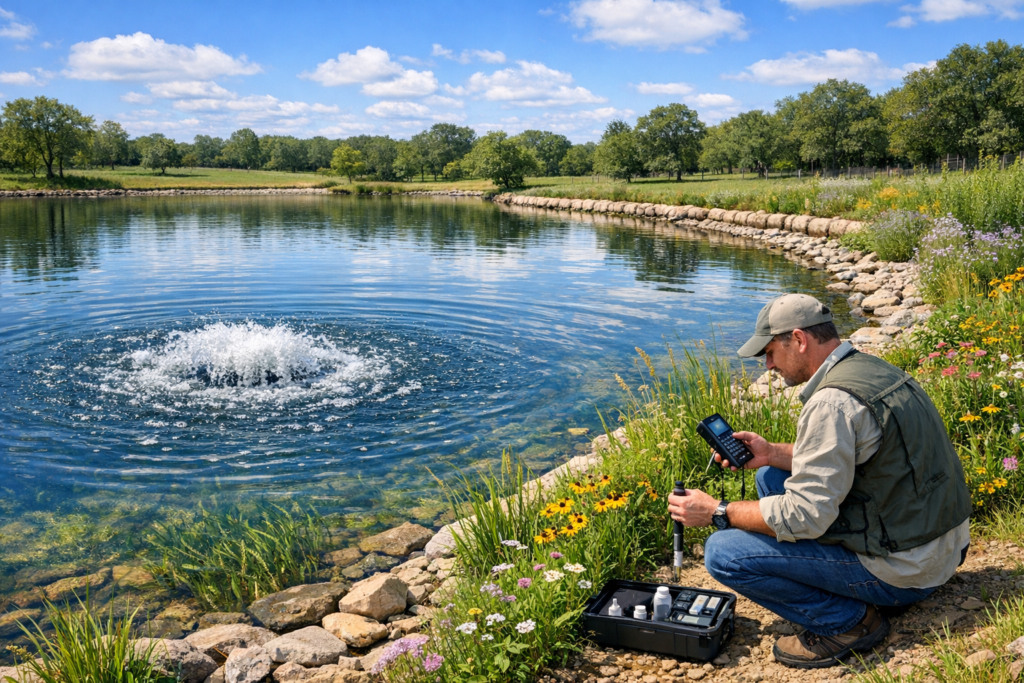
A simple water quality test performed quarterly can catch problems while they are still inexpensive to correct. We perform these tests as part of our pond restoration services, giving landowners a clear snapshot of pH, dissolved oxygen, nutrient concentrations, and turbidity. When you know what is happening in your water column, you can act strategically instead of reactively.
Watershed Management and Nutrient Runoff
One concept that rarely comes up in casual conversations about ponds is watershed management. Every pond and lake sits at the bottom of a drainage area. Whatever happens on the land surrounding your water — fertilizer application, cattle grazing, construction, even mowing — eventually flows into your pond. We educate our Canton TX clients about how nutrient management upstream can prevent expensive algae control and vegetation control problems downstream.
For instance, establishing a vegetated buffer zone of native grasses and wildflowers around your shoreline filters runoff before it enters the water. This best management practice, often referred to as a BMP, is one of the cheapest and most effective tools in pond and lake management. We have seen clients cut their annual aquatic weed control costs by more than half simply by controlling nutrient inputs at the source through smart watershed management.
Aeration Systems and Vegetation Control: The Two Fixes That Pay for Themselves
If we had to pick just two upgrades that deliver the greatest return on investment for East Texas pond and lake owners, it would be aeration systems and a solid vegetation control plan. Together, they address the root causes of most pond problems — low oxygen and excessive plant growth — before those problems become emergencies requiring costly pond rehabilitation.
How Aeration Systems Transform Pond Health
Aeration systems work by circulating water and increasing dissolved oxygen throughout the entire water column. Without adequate oxygen levels, beneficial bacteria cannot break down organic material on the bottom. Muck accumulates, nutrients recycle into the water, and algae thrives. We install both diffused bottom aeration systems and surface fountains and aerators depending on the depth, shape, and purpose of each pond.
Here is what proper aeration accomplishes:
– Raises dissolved oxygen to levels that support healthy fish habitat improvement
– Reduces stratification that leads to summer and fall turnover fish kills
– Accelerates natural decomposition of organic sediment, delaying the need for pond dredging
– Improves water clarity by promoting beneficial microbial activity
– Discourages mosquito breeding on the surface
For trophy bass ponds, aeration is non-negotiable. Bass require consistent oxygen levels to grow large and reproduce successfully. For livestock ponds, aeration keeps the water safe for cattle and reduces the risk of harmful algae blooms and fish kills. We have installed fountains and aerators on recreational ponds and lakes throughout Canton TX that not only improved water quality but also boosted the property value of the surrounding land.
Our clients are consistently amazed at the difference a properly sized aeration system makes. One rancher east of Canton TX told us his pond had been green and smelly for three years. Within six weeks of installing a bottom diffuser system, the water clarity improved dramatically and the algae was gone. That single investment in pond and lake maintenance eliminated the need for repeated chemical treatments that had been costing him over a thousand dollars a year.
Vegetation Control and Algae Control Done Right
Aquatic weed control is another area where small, consistent actions prevent massive expenses. When invasive aquatic plants like hydrilla, milfoil, or duckweed gain a foothold, they can choke a pond in a single growing season. Removing established invasive aquatic plants is far more expensive than preventing them. We build vegetation control programs around each client’s specific pond, taking into account the species present, the pond’s intended use, and the surrounding watershed.
Algae control follows similar logic. Rather than dumping algaecide after a bloom has already formed, we focus on the conditions that allow algae to flourish in the first place. That means managing nutrients, maintaining healthy oxygen levels through aeration systems, and introducing beneficial bacteria that compete with algae for resources. These best management practices form the backbone of our pond and lake management approach and consistently save our East Texas pond and lake clients money year after year.
We also recommend selective planting of desirable native aquatic vegetation along shorelines. These plants outcompete invasive aquatic plants for nutrients while simultaneously providing fish habitat improvement and shoreline erosion control — a triple benefit from a single, affordable intervention.
Shoreline Restoration and Leak Repair: Protecting Your Pond’s Structure
A pond is only as good as the structure that holds it together. Shoreline erosion and leaks are two of the most common structural problems we encounter in our pond restoration services across the Canton TX area. Both start small, both are easy to overlook, and both can result in catastrophic failure if ignored.
Shoreline Erosion Control That Actually Lasts
Shoreline erosion is a slow thief. It steals inches of bank every year, dumps sediment into your pond, reduces depth, increases turbidity, and eventually undermines dam integrity. We see this constantly on East Texas pond and lake properties where wave action from wind, livestock traffic, or boat wakes gradually eats away at unprotected banks.
Effective shoreline restoration involves a combination of techniques tailored to the specific erosion pattern:
– Riprap placement along high-energy banks where wave action is strongest
– Native plant buffer installation using deep-rooted grasses and shrubs that stabilize soil
– Bioengineering methods like coir logs and live stakes for a natural look with structural strength
– Livestock exclusion fencing to redirect cattle to designated watering points
These erosion control measures are a core part of our lake restoration services. A properly stabilized shoreline can last decades with minimal maintenance, whereas an eroding bank will continuously dump sediment into your pond, accelerating the need for expensive pond dredging.
One of the best management practices we recommend to every Canton TX property owner is to walk the full perimeter of their pond at least twice a year. Look for undercut banks, exposed tree roots, bare soil, and areas where water is seeping through the dam. Catching shoreline erosion early is one of the simplest fixes that saves the most money.
Pond Leak Detection and Repair
Nothing is more frustrating than watching your pond level drop without explanation. Pond leak detection and repair is one of our most requested services, and for good reason — a leaking pond can lose thousands of gallons a day. We use a combination of visual inspection, dye testing, and in some cases bathymetric survey technology to pinpoint exactly where water is escaping.
Common causes of leaks include:
– Deteriorated or punctured pond liners
– Porous soil conditions, especially in sandy East Texas soils
– Animal burrows from muskrats, crawfish, or armadillos
– Cracked or settled overflow pipes and spillways
For pond liner repair, we assess the extent of the damage and determine whether a patch, a full liner replacement, or an alternative sealant approach makes the most sense. In many cases, polymer sealant applications can seal small leaks without draining the pond. Polymer applications work by suspending fine particles in the water column that are drawn into leak pathways by the flow of escaping water, where they set and form a seal.
Pond leak detection and repair performed early can cost a few hundred dollars. Waiting until the pond is nearly empty, the fish are dead, and the banks have cracked from drying can easily push costs into the tens of thousands. This is exactly the kind of scenario where pond and lake restoration done proactively pays for itself many times over.
Planning Ahead: Bathymetric Surveys, Dredging, and Long-Term Pond Rehabilitation
Some problems cannot be solved with aeration or vegetation management alone. When decades of sediment have accumulated, when the pond has lost significant depth, or when the entire ecosystem needs a reset, it is time to talk about more intensive pond rehabilitation. But even these larger projects can be managed intelligently to minimize cost and maximize results.
Bathymetric Surveys for Smarter Decisions
Before any major pond dredging or restoration project, we recommend a bathymetric survey. Depth mapping tells us exactly how much sediment has accumulated, where the deepest and shallowest areas are, and how the pond’s contour has changed over time. This data is critical for planning efficient dredging operations, designing fish habitat improvement structures, and calculating accurate project budgets.
Without a bathymetric survey, dredging becomes guesswork. Contractors may remove too little sediment to make a difference or too much in the wrong areas, wasting time and money. We use this depth mapping data to create targeted pond dredging plans that restore volume where it matters most — near the dam, around aeration systems, and in areas designated for fish habitat improvement in trophy bass ponds and recreational ponds and lakes.
Pond Dredging and Full-Scale Restoration
Pond dredging is the most intensive form of pond and lake restoration, but when it is needed, there is no substitute. Over time, organic sediment, eroded soil, and decomposed plant material fill in the bottom of every pond. Livestock ponds are especially susceptible because cattle activity accelerates bank erosion and nutrient loading. We have restored livestock ponds in Canton TX that had lost more than half their original volume to silt.
Our lake restoration services for larger water bodies follow a similar process but on a bigger scale. We coordinate sediment disposal, manage dewatering logistics, and often combine dredging with shoreline restoration to prevent the problem from recurring.
The key insight we share with every client is this: pond rehabilitation done on a schedule is always cheaper than pond rehabilitation done in an emergency. When you combine regular pond and lake maintenance — water quality testing, aeration systems, vegetation control, shoreline erosion control — with periodic depth assessments, you dramatically extend the life of your pond and avoid the kind of catastrophic failure that costs a fortune to fix.
Property value is another factor worth mentioning. A well-maintained pond or lake on your Canton TX property is a significant asset. Real estate data consistently shows that waterfront features increase property value, but only when the water looks clean and the banks are stable. Neglected, algae-choked ponds with eroding shorelines actually decrease perceived value. Our pond and lake management programs are designed to protect both the ecological health and the financial value of your water feature.
Take the First Step Before the Next Problem Takes Your Wallet
Everything we have covered in this article comes down to one principle: early action beats expensive reaction. Whether it is a simple water quality test, an aeration system installation, a pond liner repair, or a full-scale pond dredging project, the sooner you address a problem, the less it costs. We have built Arrowhead Pond Restoration around this philosophy because we have seen too many East Texas pond and lake owners pay far more than they needed to simply because they waited too long.
Our pond restoration services cover everything from algae control and aquatic weed control to shoreline restoration, pond leak detection and repair, polymer sealant applications, and comprehensive pond and lake restoration planning. We serve Canton TX and surrounding communities with the same hands-on, knowledgeable approach that has earned us the trust of hundreds of landowners across the region.
If you own a pond or lake and you have been putting off that nagging concern — the dropping water level, the green water, the crumbling bank — now is the time to act. Reach out to our team today at arrowheadpondresto.com for a consultation. We will help you identify the simple fixes that protect your investment, your property value, and your peace of mind for years to come.