Why Brush Clearing Services Matter More Than Most Pond Owners Realize
If you own a pond or lake in East Texas, there is a good chance you have stared at an overgrown shoreline and wondered where things went wrong. Maybe the cattails crept in slowly, or maybe a wall of yaupon holly and greenbrier now blocks every path to the water. We hear this story almost every week at Arrowhead Pond Restoration. The truth is that neglected vegetation around a pond does not just look bad. It chokes water flow, accelerates sedimentation, invites invasive species, and quietly erodes the value of your property. That is exactly why professional brush clearing services should be one of the first conversations any pond owner has, not the last.
In Murchison TX and throughout Henderson County, we have spent years helping ranchers and property owners reclaim their land from aggressive brush. Our passion is giving people back the ponds, pastures, and shorelines they envisioned when they first purchased their property. In this article, we are going to share the brush clearing secrets we wish every pond owner knew from day one, covering the methods, the equipment, the environmental benefits, and the mistakes that cost people thousands of dollars down the road.
The Hidden Costs of Ignoring Overgrown Brush Around Your Pond
Most property owners in Murchison TX do not wake up one morning and decide to let brush take over. It happens gradually. A few seasons of unchecked growth, a couple of wet years that supercharge woody vegetation, and suddenly the shoreline looks nothing like it did five years ago. But what many people fail to realize is that overgrown brush around a pond triggers a cascade of expensive problems.
Erosion, Sedimentation, and Water Quality Decline
When dense brush crowds the edge of a pond, it might seem like the roots are holding soil in place. In reality, the wrong type of vegetation often does the opposite. Shallow-rooted invasive species displace the native grasses that actually provide erosion control and soil stabilization. Once those natives disappear, every heavy rain washes topsoil straight into your pond. Over time, your pond basin fills with sediment, water depth decreases, and the fishery suffers.
We have seen ponds in East Texas lose two to three feet of depth in under a decade simply because the shoreline vegetation was never managed. That sediment does not just reduce water volume. It carries nutrients that fuel algae blooms, degrade water clarity, and create an environment where game fish struggle to reproduce. Proper vegetation removal along the shoreline is one of the most effective ways to protect water quality and extend the functional life of your pond.
Lost Access, Lost Value, and Fire Risk
Beyond water quality, unmanaged brush creates practical headaches. Overgrown fence lines become impossible to maintain. Access roads disappear under a canopy of mesquite and eastern red cedar. And in a region where summer heat and dry conditions are a fact of life, dense brush dramatically increases wildfire risk reduction concerns. Creating defensible space and fire breaks around structures, ponds, and pastures is not optional in East Texas—it is essential.
There is also the financial reality. Appraisers and potential buyers notice when a property is well managed versus when it is buried in brush. Improving land value is one of the most tangible returns on investment you can get from land clearing services. We routinely work with ranchers and property owners who are stunned by how much more functional and attractive their property becomes after a single round of professional brush removal.
Brush Clearing Services in Murchison TX: Methods That Actually Work
Not all brush clearing is created equal. The approach that works for a highway right-of-way is not necessarily the right fit for a sensitive pond shoreline. At Arrowhead Pond Restoration, we tailor every project to the specific goals of the landowner, the condition of the terrain, and the ecological needs of the site. Here is a breakdown of the methods we rely on most and why they matter for pond and lake owners.
Forestry Mulching: The Gold Standard for Low-Impact Land Management
If you have done any research into brush clearing near me, you have almost certainly encountered forestry mulching. There is a reason it dominates the conversation. Forestry mulching uses a single machine, typically a skid steer or specialized tracked carrier fitted with a rotary drum mulching head, to cut, grind, and spread vegetation in one pass. The result is a layer of organic mulch left on the ground that protects soil, retains moisture, and prevents erosion.
We consider forestry mulching the backbone of low-impact land management for several reasons:
– It eliminates the need for hauling, burning, or piling debris, which means safe brush disposal is built into the process.
– The mulch layer provides immediate erosion control and soil stabilization, which is critical near pond banks.
– It selectively targets unwanted brush while preserving desirable hardwoods and native grasses.
– The mechanical brush clearing equipment used in forestry mulching can navigate slopes, wet areas, and tight spaces that traditional bulldozers cannot handle without causing significant ground disturbance.
For pond and shoreline brush clearing, forestry mulching is often our first recommendation. It allows us to restore sight lines to the water, eliminate invasive species control problems like privet and Chinese tallow, and leave the soil structure intact so that native vegetation can reestablish quickly.
Brush Cutting and Mulching Combined With Targeted Removal
Some projects call for a combination approach. When we encounter large-diameter trees, significant deadfall, or brush so dense that a single piece of mechanical brush clearing equipment cannot handle everything efficiently, we integrate brush cutting and mulching with targeted chainsaw work and, when appropriate, excavator-assisted removal. This is common when we are doing land clearing for ponds and lakes where we need to reshape a bank or remove root masses that are undermining a dam.
We also use this combined approach for right-of-way clearing along fence lines, driveways, and access roads. Many of our clients in Murchison TX own working ranches where maintaining clear boundaries and functional infrastructure is just as important as managing the pond. Brush cutting and mulching keeps those corridors open without the heavy soil disturbance you get from a traditional dozer push.
The key takeaway here is that professional brush removal is not a one-size-fits-all service. A thorough property assessment before any equipment rolls onto your land ensures you get the right method for the right situation, which saves time, money, and headaches.
Pond and Shoreline Brush Clearing: A Step-by-Step Look at Our Process
When someone reaches out to us for brush clearing near me in the East Texas region, we follow a consistent process designed to protect the landowner’s investment and the health of the pond ecosystem. Here is how a typical pond and shoreline brush clearing project unfolds with Arrowhead Pond Restoration.
Site Assessment and Planning
Every project begins with a property assessment. We walk the site with the landowner to understand their goals, whether that is lake and pond shoreline restoration, pasture reclamation, wildlife habitat management, or simply being able to see the water from the house again. During this site assessment, we identify the species of brush present, evaluate soil conditions, note any erosion hotspots, and check for any permits and environmental regulations that may apply.
In Texas, most private landowners have considerable freedom to manage vegetation on their own property, but there are situations, particularly near waterways classified as waters of the United States or within floodplain zones, where permits and environmental regulations come into play. We help our clients navigate that landscape so there are no surprises.
We also verify our own safety standards and insurance coverage with every client. Arrowhead Pond Restoration is fully licensed and insured, which protects both our crew and the property owner throughout the project.
Execution: From Overgrown to Open
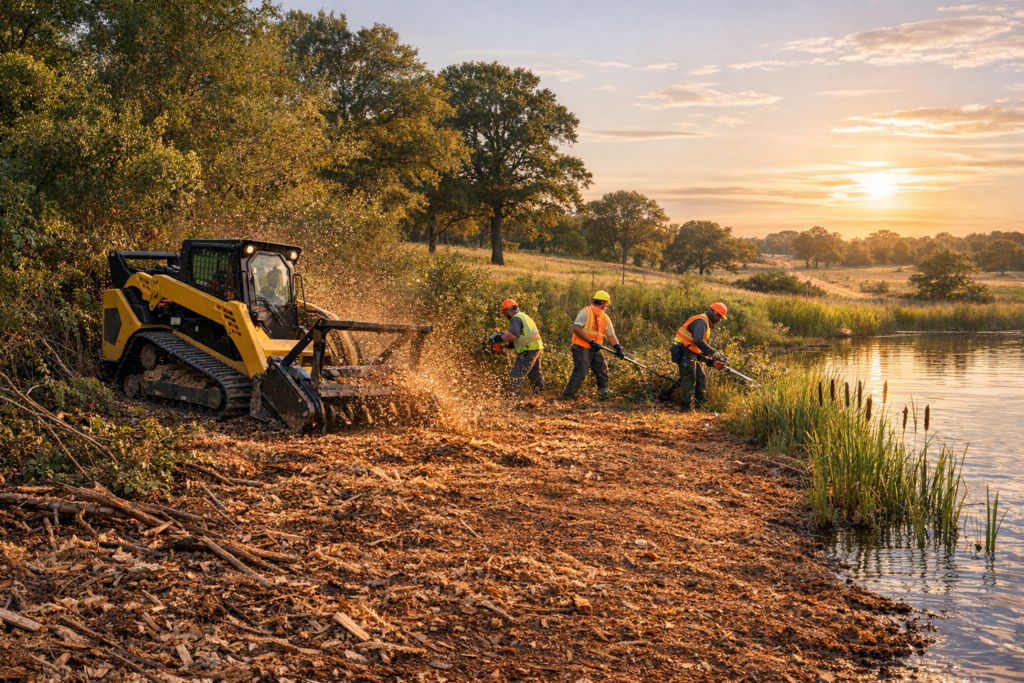
Once the plan is in place, our crew mobilizes the appropriate mechanical brush clearing equipment to the site. For most pond and shoreline brush clearing jobs, that means a forestry mulching head mounted on a tracked skid steer, supplemented by handheld tools for detail work in tight spots.
We work in sections, starting from the perimeter and moving toward the waterline. This staged approach gives us control over debris flow and ensures we are not pushing material into the pond. As vegetation removal progresses, we selectively retain desirable trees that provide shade, bank stabilization, and wildlife habitat management value. Native oaks, pecans, and bald cypress are examples of species we almost always preserve.
For clients who need pasture and ranch land clearing in addition to shoreline work, we extend the project footprint to reclaim overgrown fields and fence lines. Pasture reclamation is one of the most satisfying transformations we perform. Fields that have been lost to mesquite and juniper for years suddenly become productive grazing land again, and the improved drainage benefits the pond downstream.
Post-Clearing Stabilization and Maintenance
Brush clearing near me searches often lead people to companies that cut and leave. We take a different approach. After the initial vegetation removal is complete, we address erosion control and soil stabilization before we consider the job finished. That might mean seeding exposed banks with native grasses, installing erosion blankets on steep slopes, or adjusting drainage patterns to reduce concentrated water flow into the pond.
We also talk with every client about a long-term maintenance plan. Brush does not give up easily in East Texas. Without a follow-up strategy, regrowth can reclaim a cleared area in as little as two to three growing seasons. Annual or biannual brush cutting and mulching passes keep the landscape open, the shoreline accessible, and the pond healthy. This ongoing approach to pond and lake management services is what separates a one-time clearing from a true restoration.
East Texas Brush Clearing: Why Local Expertise Makes the Difference
There is no shortage of land clearing services advertising across the state. But East Texas brush clearing is its own discipline. The species mix here, the soil types, the rainfall patterns, and the density of growth are fundamentally different from what you encounter in the Hill Country, the Blackland Prairie, or the Panhandle. That matters because the wrong approach can cause more harm than good.
Understanding the East Texas Landscape
In Murchison TX and the surrounding area, we deal with a specific cast of characters when it comes to invasive species control. Chinese tallow trees spread aggressively along pond margins. Yaupon holly forms impenetrable thickets. Greenbrier tangles through every understory. Eastern red cedar marches across open pastures and drinks water like nothing else. Each of these species requires a slightly different strategy for effective vegetation removal and long-term suppression.
Our team has cleared thousands of acres across East Texas, and that experience informs every decision we make on your property. We know which species resprout aggressively after cutting and which ones are effectively killed by a single forestry mulching pass. We know which soil types are most vulnerable to erosion after clearing and where we need to be especially careful near pond dams and spillways. That kind of local knowledge is not something you get from a crew driving in from three counties away.
Building Lasting Relationships With Ranchers and Property Owners
At Arrowhead Pond Restoration, we are not just a brush clearing company. We are a land clearing for ponds and lakes specialist with deep roots in this community. Many of our clients come to us first for Arrowhead Pond Restoration brush clearing and then discover the full range of pond and lake management services we offer, from fish stocking consultations to aeration system installation to dam repair.
That integrated approach is what makes us different. When we clear brush from your shoreline, we are thinking about how that work connects to water quality, fish habitat, erosion control, and the long-term health of your entire property. We are not just making it look nice for a season. We are setting the foundation for a pond that performs well for decades.
East Texas brush clearing done right is an investment in your land, your water, and your peace of mind. Whether you need wildfire risk reduction around a homesite, pasture and ranch land clearing to bring fields back into production, or a full lake and pond shoreline restoration, the principles are the same: assess carefully, clear thoughtfully, stabilize thoroughly, and maintain consistently.
Take the First Step Toward Reclaiming Your Property
If you have made it this far, you already understand that professional brush removal is not a luxury. It is a necessity for anyone who owns a pond, lake, or rural property in East Texas. The secrets we have shared here, from the power of forestry mulching to the importance of erosion control and soil stabilization, from invasive species control to wildfire risk reduction, are the same principles we apply on every job site in Murchison TX and beyond.
Improving land value, restoring wildlife habitat management potential, and reclaiming your shoreline all start with a single conversation. We encourage you to reach out for a property assessment so we can walk your land together and build a plan tailored to your goals.
Our team at Arrowhead Pond Restoration is ready to help you take back your property from the brush. Whether you need land clearing services for a single pond bank or a comprehensive pasture reclamation project across hundreds of acres, we bring the equipment, the expertise, and the commitment to do it right.
Contact us today at https://arrowheadpondresto.com/ to schedule your free site assessment. Let us show you what your land is supposed to look like.