Why Salvage Boat Recovery Matters So Much In Van Zandt County TX
When a boat starts to sink, capsize, or settle into the mud at the bottom of a pond, most owners feel overwhelmed. Around Van Zandt County TX, we see this happen after unexpected storms, failed bilge pumps, or simple neglect. Salvage boat recovery is not just about pulling a hull out of the water; it’s about protecting your property value, your shoreline, and the long‑term health of your pond or lake.
Our team has learned that time is the most important factor. The longer a damaged boat sits, the more fuel, oil, and debris can leach into the water. That’s why we treat boat salvage services as an emergency environmental issue, not just a mechanical one. When we roll out with a salvage vessel or work barge, we’re thinking about both the owner’s investment and the ecosystem living in that water.
In Van Zandt County TX, many boats sit on private ponds, small lakes, and shared rural properties. Traditional coastal-style marine salvage operations don’t always fit these environments. Instead, we specialize in inland lake and pond salvage designed specifically for tight access, shallow water, and soft bottoms. Whether we’re dealing with a bass boat that slid off the trailer or a pontoon that broke free in a windstorm, our salvage boat recovery process is adapted to our local conditions.
We also understand that owners are worried about the cost of salvage boat recovery. Our job is to explain clearly what needs to be done, what can be safely skipped, and how we can coordinate with your marine liability insurance so you’re not left guessing. From emergency boat recovery after a storm to methodical wreck removal and debris clearing for derelict and abandoned vessels, we want you to understand every step before we start. That confidence is often what saves a “sinking” project from turning into a long‑term headache.
From Panic To Plan: How Professional Boat Salvage Services Actually Work
When something goes wrong on the water, emotions run high. We’ve seen owners in Van Zandt County TX scrambling to grab ropes, tractors, or even farm equipment to pull a boat out. While that instinct is understandable, a rushed attempt can worsen hull damage, spread contamination, and raise the ultimate cost of salvage boat recovery. Having a clear plan makes all the difference.
Step 1: Rapid Response And On‑Site Evaluation
Our first priority is a rapid response salvage team. When you call us for emergency boat recovery, we gather key details:
– Type and size of vessel
– Location and water depth
– Visible damage and whether the boat is still afloat, partially sunk, or fully submerged
– Presence of fuel, oil sheen, or batteries in the water
Once on site, we perform an initial safety check and quick underwater inspection when necessary. This helps us locate leak points, entanglements, and any obstacles that might complicate sunken boat recovery. In shallow ponds, we often wade carefully with poles and sonar tools to map out the situation before we move a single piece of gear.
This evaluation also includes an early hull damage assessment. We look for:
– Cracked seams and punctures
– Broken transoms or engines torn loose
– Compromised steering, fuel, and electrical systems
By understanding the structural condition, we can choose the right towing and lifting equipment and avoid ripping the boat apart during the lift.
Step 2: Stabilizing The Scene And Protecting The Water
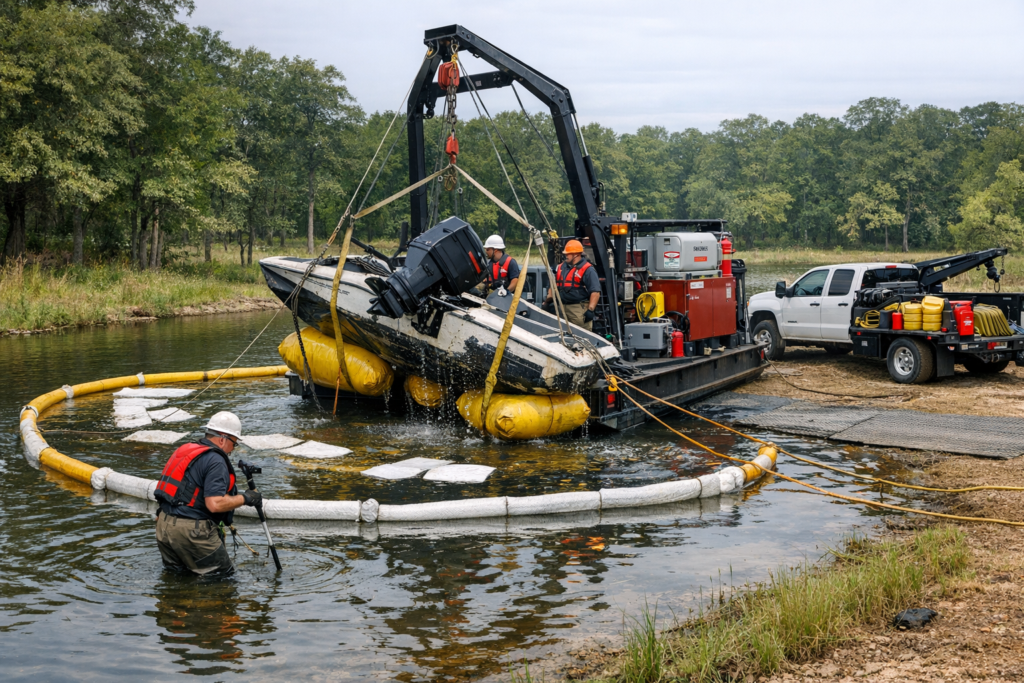
Before we move a boat, we stabilize the situation. This is where professional boat salvage services differ from DIY attempts. Our team sets up:
– Pollution control booms around the vessel if there is any sign of fuel or oil
– Environmental containment and cleanup gear such as absorbent pads, skimmers, and collection containers
– Lines to keep the boat from drifting into docks, shorelines, or other structures
If the vessel is at risk of sliding into deeper water, we secure it with anchors, stakes, or connections to our salvage vessel or work barge. In some cases, we must begin bilge and fuel removal before lifting, especially if the boat is still partially afloat but clearly compromised. Pumping out contaminated bilge water into containment tanks is critical to protecting shoreline and water quality.
During this stabilization phase, we also complete more detailed safety protocols and risk assessment:
– Are there hidden electrical hazards?
– Are there propane tanks, batteries, or other dangerous materials?
– Is the boat creating a navigation hazard that needs immediate removal?
By addressing these questions early, we manage the risk to everyone on site and to the environment.
Step 3: Planning The Lift, Tow, Or Break‑Down
Once the vessel is stabilized and contained, we map out the actual sunken boat recovery or capsized boat salvage operation. Our choices typically include:
– Using lift bags and winches to re‑float and stabilize the boat
– Employing cranes or A‑frames from a salvage vessel or work barge in deeper ponds
– Dragging and rolling techniques for small craft recovery in very shallow water
– Sectional removal when derelict and abandoned vessels are too fragile to lift whole
For most inland lake and pond salvage projects in Van Zandt County TX, we rely on compact towing and lifting equipment that can be trailered in and operated from the shoreline or a small barge. Lift bags and winches allow us to raise boats carefully, keeping stress off damaged hull sections and controlling the ascent.
Every step is documented, especially if we anticipate the need for insurance claim support for boat salvage. Photos, notes, and measurements help you work with your marine liability insurance adjuster, and they also protect your rights under salvage law and ownership rights if there are any disputes later.
Inside The Process: Techniques That Make Or Break Salvage Boat Recovery
Behind every smooth salvage job is a sequence of proven techniques. Over the years working in Van Zandt County TX, we’ve refined our approach for ponds and small lakes where big‑water methods don’t always translate. Our goal is to complete salvage boat recovery efficiently while minimizing additional damage and environmental impact.
Underwater Inspection, Lifting Gear, And Controlled Refloating
For fully submerged boats, our underwater inspection phase is crucial. Even in relatively clear East Texas ponds, suspended silt can drastically reduce visibility when we start working. We use:
– Probing poles and underwater cameras
– Divers in appropriate gear when depth and conditions justify it
– Sonar or scanning devices in deeper or more turbid ponds
This underwater inspection pinpoints entanglement in stumps, dock chains, or debris, and it tells us where to attach lift bags and winches. Proper attachment points help distribute forces so we don’t tear through a weakened hull.
Our towing and lifting equipment for inland jobs usually includes:
– Air‑filled lift bags sized to the vessel’s displacement
– Manual and powered winches on tripods, vehicles, or a work barge
– Tow lines, snatch blocks, and anchors to redirect and balance loads
The sequence often looks like this:
1. Secure the boat with control lines.
2. Attach lift bags and winches at structurally sound points.
3. Add air to lift bags gradually, monitoring the angle and rise of the hull.
4. Use winches to guide the boat toward shallower water or a ramp as it gains buoyancy.
By raising the boat in stages, we limit stress and make it easier to maintain environmental containment and cleanup around the operation.
Environmental Containment, Hazardous Materials, And Cleanup
Any professional boat salvage services provider must be equally focused on environmental protection. In Van Zandt County TX, many ponds serve multiple purposes: fishing, livestock, irrigation, and recreation. One spill left unmanaged can affect all of that.
Our environmental containment and cleanup process often includes:
– Deploying pollution control booms around the vessel and the work area
– Using absorbent pads and socks to capture surface fuel or oil
– Setting up pumps and filters for controlled bilge and fuel removal
When we talk about hazardous material handling, we’re not just referring to fuel. We also manage:
– Lead‑acid or lithium batteries
– Hydraulic fluids from steering or trim systems
– Old paint and bottom coatings flaking off during the lift
Each of these materials must be collected, labeled, and disposed of properly. We follow strict safety protocols and risk assessment guidelines to keep our crew and your property safe while we work.
Once the boat is out of the water, we complete a more detailed hull damage assessment in a safe staging area. This helps owners and insurers decide whether repair or disposal makes more sense. If the boat is beyond saving, we can assist with derelict and abandoned vessels removal, including cutting up the hull, disposing of components, and performing final wreck removal and debris clearing from the shoreline or lake bottom.
Managing Navigation Hazards And Long‑Term Pond Health
Even on private ponds, navigation hazard removal is important. Submerged hulls, broken docks, and scattered debris pose risks to other boats, swimmers, and livestock. As part of our pond and lake boat recovery work, we often:
– Sweep the bottom for loose debris with rakes, magnets, or grapples
– Remove anchors, cables, and lines that might snag props or nets
– Inspect nearby structures such as docks, piers, and boat lifts for storm damage
For us, protecting shoreline and water quality is not just a slogan; it’s how we protect the investment you’ve made in your property. Salvage boat recovery done correctly leaves your pond safer, cleaner, and ready to use again rather than turning it into a dumping ground.
Van Zandt County TX Realities: Inland Lake And Pond Salvage Challenges
Working in coastal waters is very different from handling inland lake and pond salvage in a place like Van Zandt County TX. Our area brings a unique mix of small impoundments, ranch ponds, community lakes, and private fishing waters. Each one has its own quirks, and we’ve adjusted our salvage boat recovery process to match.
Shallow Water, Soft Bottoms, And Tight Access
Many properties here don’t have a formal boat ramp or wide shoreline access. That’s a real challenge for boat salvage services because standard trailers and heavy cranes can’t always reach the water’s edge safely. Instead, we often:
– Use compact, track‑mounted equipment that can cross soft ground with minimal rutting
– Launch a small salvage vessel or work barge from improvised access points
– Build temporary cribbing or matting to stabilize lifting equipment near the bank
Soft, silty bottoms complicate sunken boat recovery because vessels tend to settle and “suction” into the mud. We counter this by:
– Using lift bags and winches to break the suction gradually
– Digging and jetting around the hull when needed to reduce resistance
– Pulling the boat along a carefully chosen path that avoids stumps and steep drop‑offs
In many Van Zandt County TX ponds, visibility is poor, so underwater inspection relies heavily on feel and experience. We’ve learned how to read the pond bottom and structure layout from the shoreline and from sonar to avoid unnecessary disturbance.
Private Property Boat Recovery And Legal Considerations
Most of our projects here are private property boat recovery jobs, which raises a different set of questions than public waterways. We walk owners through important issues such as:
– Who actually owns the vessel?
– Is the boat technically a derelict and abandoned vessel?
– How does salvage law and ownership rights apply on private, non‑navigable waters?
While we always recommend you consult with your own attorney or insurer on specific legal matters, we can share our practical experience. In many cases, the property owner has the authority—and the responsibility—to order navigation hazard removal and wreck removal and debris clearing to keep the pond safe and compliant with local regulations.
We also help owners gather documentation needed for insurance claim support for boat salvage. That often includes:
– Photos before, during, and after salvage
– Written description of the incident and conditions
– Invoices for salvage, environmental containment and cleanup, and disposal
Insurance adjusters are especially interested in evidence that proper hazardous material handling and environmental precautions were taken. This is where our detailed approach can pay off, often reducing disputes over coverage and the cost of salvage boat recovery.
Coordination, Compliance, And Risk Management
While we’re inland, there are still times when USCG / Coast Guard coordination becomes relevant, especially if a vessel originated from or is registered for use on navigable waters. More commonly, though, we coordinate with:
– Local emergency responders when there’s an accident or injury
– County officials if a boat becomes a public hazard on shared water
– Environmental agencies if there’s a significant spill risk
Our safety protocols and risk assessment framework keeps everyone aligned. Before we begin any major emergency boat recovery, we review:
– Site access plans and safe work zones
– Potential impact on dams, spillways, or irrigation intakes
– Weather conditions that might complicate capsized boat salvage
By taking the time to plan, we reduce the chance of secondary accidents, unfinished jobs, or partial cleanups that leave problems behind for someone else to deal with later.
Costs, Insurance, And Smart Decisions About Your Sinking Project
We know that owners in Van Zandt County TX don’t just want to understand the technical side of salvage boat recovery—they want to know how it affects their wallets. Our goal is to help you make informed decisions, minimize surprises, and protect your long‑term interests.
What Drives The Cost Of Salvage Boat Recovery?
The cost of salvage boat recovery varies, but there are clear factors that raise or lower the bill:
– Location and accessibility of the pond or lake
– Size and type of vessel (from jon boats to larger pontoons)
– Depth of water and degree of submersion
– Level of hull damage and structural instability
– Amount of pollution control booms, cleanup materials, and bilge and fuel removal required
A straightforward small craft recovery from a shallow shoreline with minimal damage can be relatively affordable. On the other hand, complex sunken boat recovery in deeper water with significant environmental contamination and structural failure requires more specialized towing and lifting equipment, more labor, and more follow‑up work.
We are always upfront about estimated costs before we start. When we see multiple options—such as partial salvage followed by dismantling versus full refloating and towing—we explain those options and their price ranges so you can choose what best fits your situation.
Working With Insurance And Protecting Your Rights
Many boat owners don’t realize how their marine liability insurance applies until something goes wrong. We regularly help clients prepare documentation and communicate with adjusters for insurance claim support for boat salvage. While we don’t control your insurer’s decisions, we can make sure you have:
– Detailed invoices that separate salvage, environmental containment and cleanup, and disposal
– Evidence of hull damage assessment and repair estimates
– Written records of navigation hazard removal and wreck removal and debris clearing
Adjusters often ask whether the incident involved negligence, storms, faulty equipment, or other covered events. Our reports on weather, water conditions, and apparent failure points can support your claim.
We also encourage owners to think about salvage law and ownership rights, especially on shared or leased water. If a derelict and abandoned vessel is left on your property by someone else, you may need documentation to show that you made reasonable efforts to locate the owner and mitigate risks before dismantling or disposing of the boat. Our experience with these scenarios in East Texas boat salvage work is a resource you can lean on.
Planning Ahead To Avoid The Next Emergency
The best emergency boat recovery is the one you never need. After we complete a job, we often talk with owners about prevention. Some of the most effective steps include:
– Regularly checking and maintaining bilge pumps and float switches
– Securing boats firmly when stored on bank or dock
– Removing fuel and batteries from seasonal or little‑used boats
– Scheduling periodic underwater inspection of moored vessels and dock structures
These simple measures dramatically reduce the risk of another capsized boat salvage call. They also protect shoreline and water quality by reducing the chance of sudden leaks and spills.
For us, boat salvage services are part of a broader commitment to healthy ponds and lakes across Van Zandt County TX. We want our neighbors to enjoy safe, clean water and reliable access to their boats without living in fear of the next storm or equipment failure.
When everything goes wrong on the water, you don’t have to choose between protecting your investment and protecting your pond. With the right salvage vessel or work barge, lift bags and winches, and a team that understands both salvage and lake ecology, it’s possible to save your project and your shoreline at the same time.
If you’re facing a sinking, capsized, or stranded boat on your property—or if you simply want expert advice before a small problem becomes a disaster—our team is ready to help. Learn more about how we combine pond management, pond and lake boat recovery, and full environmental cleanup at https://arrowheadpondresto.com/, and contact us today to talk through your situation before it gets worse.