
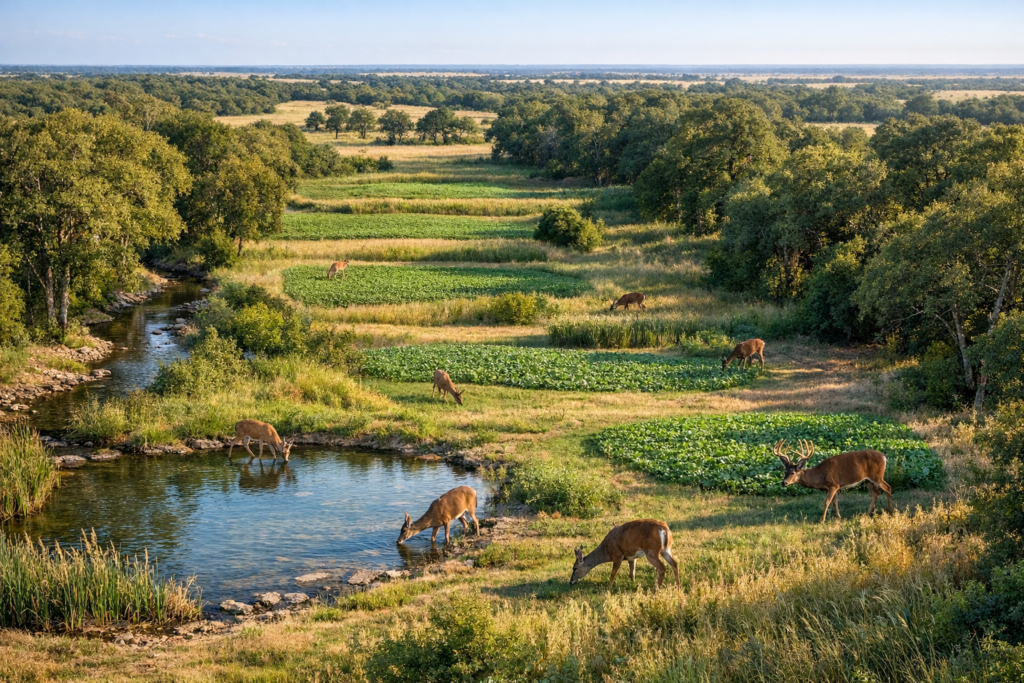
If you own land in Navarro County TX and have wondered what it would take to transform overlooked pastures or timber edges into thriving wildlife habitat, you are not alone. We talk with landowners every week who want to attract and hold more deer, yet they are unsure where to start. The answer almost always begins with food plot planning and planting for deer and wildlife. When you combine the right seed, the right soil work, and a thoughtful layout that accounts for water, wind, and seasonal nutrition, even a modest tract can become a destination for whitetail. Our team at Arrowhead Pond Restoration has spent years helping East Texas and Central Texas landowners build complete habitat systems, and food plot planning is one of the most rewarding pieces of that puzzle.
Why Food Plot Planning Matters More Than Most Landowners Realize
We have seen it dozens of times: a landowner buys a bag of seed, broadcasts it across a random clearing, and then wonders why nothing grows or why the deer never seem to use the spot. The truth is that successful deer food plots are built long before the first seed hits the ground. Food plot planning is the process of choosing where, when, what, and how you plant so that every acre of forage serves a purpose in your overall wildlife management program.
The Difference Between a Food Plot and a Feeding Station
A food plot is not a pile of corn under a feeder. It is a living, regenerating source of nutrition for whitetail deer and other wildlife that can provide protein, energy, and minerals across multiple seasons. When food plot planning is done correctly, you create a year-round food plot strategy that keeps deer cycling through your property from January through December. That level of consistency is what separates properties that merely see deer from properties that hold deer on your property through every phase of the annual cycle.
In Navarro County TX, where post-oak savannas meet blackland prairie, the landscape gives us a unique advantage. We have enough rainfall most years to support cool-season food plots in fall and winter and warm-season food plots in spring and summer, provided we manage soil moisture and drainage properly. The key is matching our planting calendar to the local climate and understanding how each plot fits into the bigger habitat picture.
Small Property Food Plots Can Deliver Big Results
You do not need a thousand-acre ranch to make food plot planting worthwhile. Small property food plots, some as tiny as a quarter acre, can punch well above their weight when they are positioned correctly. On a 50- to 200-acre tract, a handful of well-placed plots connected by wildlife corridors and bedding areas can mimic the habitat diversity of a much larger property. The secret is intentional food plot layout and design that funnels deer movement through areas where they feel safe, where the wind works in your favor for hunting access and wind management, and where nutrition is always available.
We have helped landowners in Navarro County TX turn neglected corners, old stock tank clearings, and narrow creek bottoms into highly productive small property food plots. In every case, the process started with a plan, not a planter.
Site Selection, Soil Testing, and Seedbed Preparation for Navarro County TX
Before a single seed goes into the ground, we walk the property with two questions in mind: where will deer naturally want to feed, and where can we realistically grow high-quality forage? The intersection of those two answers determines our food plot location.
Choosing the Right Food Plot Location
Ideal food plot location depends on several factors:
– Proximity to thick cover and bedding areas where deer spend daylight hours.
– Access to wildlife water sources such as ponds, creeks, and tanks. Deer rarely travel far from water, especially during Texas summers, so integrating food plots with ponds and water sources is one of the smartest moves a landowner can make.
– Prevailing wind direction, because hunting access and wind must be considered together. If you cannot enter and exit a plot without alerting deer, the plot loses much of its hunting value.
– Sunlight exposure. Most forage species need at least four to six hours of direct sun.
– Drainage and erosion control. Low spots that hold water after a rain can drown seedlings, while steep slopes lose topsoil before plants establish. We look for gentle terrain with natural drainage, or we create it.
In Navarro County TX, creek and pond margins often provide the best combination of moisture, cover proximity, and fertile soil. That is why we frequently recommend integrating food plots with ponds and water sources as part of a unified habitat design.
Soil Testing for Food Plots Is Non-Negotiable
We cannot overstate the importance of soil testing for food plots. A basic soil test from the Texas A&M AgriLife Extension, which can be found at soiltesting.tamu.edu, will tell you your pH, phosphorus, potassium, and organic matter levels. Without this data, you are guessing at lime and fertilizer recommendations, and guessing is expensive.
In our region, many soils lean acidic under timber canopy and slightly alkaline on open prairie. Lime and fertilizer recommendations will vary by plot, but a common scenario involves applying two tons per acre of agricultural lime to raise pH into the 6.0 to 7.0 range that most food plot forages prefer. You may also need phosphorus and potassium amendments. We always tell landowners: spend forty dollars on a soil test now or waste four hundred dollars on seed that never reaches its potential.
Once soil testing for food plots is complete and amendments are applied, seedbed preparation can begin. Good seedbed preparation means removing existing vegetation through mowing, light disking, or a burndown herbicide, then working the soil to a firm, smooth surface. The goal is seed-to-soil contact. A rough, cloddy seedbed leads to uneven germination, poor stands, and wasted money. On small property food plots where equipment access is limited, we sometimes use an ATV-mounted cultipacker or even a simple drag made from a section of chain-link fence. The tools matter less than the result: a clean, level bed ready for planting.
Choosing the Right Seed Mixes and Building a Year-Round Feeding Calendar
Food plot planting is where science meets strategy. Selecting the right species and varieties for your soil type, climate zone, and management goals is critical to success. In Navarro County TX and across the broader East Texas and Central Texas region, we have the advantage of a long growing season and enough moisture in most years to support diverse plantings.
Cool-Season Food Plots for Fall and Winter Nutrition
Cool-season food plots are the backbone of most whitetail food plot programs. These plots go in the ground between mid-September and late October in our area and provide forage from November through April. Preferred species include clover, chicory, brassicas, and cereal grains such as oats, wheat, and winter rye.
– Clover, particularly crimson and arrowleaf varieties, delivers high protein that supports nutrition for whitetail deer during the stress of the rut and winter.
– Brassicas, including turnips, radishes, and rape, become extremely attractive to deer after the first hard frost converts their starches to sugars. They are outstanding for improving herd health and antler growth because of their high digestibility and mineral content.
– Cereal grains germinate quickly, establish fast, and provide early-season grazing that takes browsing pressure off other species while they mature.
– Chicory is a deep-rooted perennial that tolerates moderate drought and provides nutritious forage well into spring.
A blended approach, combining clover, chicory, brassicas, and cereal grains into a single mix, gives you species diversity that staggers maturity and creates an attractive, resilient stand. We have seen East Texas food plots using this kind of layered mix outperform single-species plantings by a wide margin in both tonnage and deer usage.
Warm-Season Food Plots for Spring and Summer Growth
The other half of a year-round food plot strategy addresses the spring and summer months, when does are lactating and bucks are in full antler development mode. Warm-season food plots planted from April through June fill this gap. Popular options include:
– Lablab, cowpeas, and soybeans for protein-rich summer forage.
– Iron clay cowpeas, which handle heat and moderate drought better than soybeans in our climate.
– Native forage and browse enhancement through selective timber management, which allows sunlight to reach the forest floor and stimulates growth of naturally occurring forbs and legumes.
Combining warm-season food plots with cool-season food plots creates the year-round food plot strategy that truly transforms a property. Deer no longer need to leave your land to find quality nutrition for whitetail deer during any season.
Perennial vs Annual Food Plot Mixes
One of the most common questions we get is whether to plant perennial vs annual food plot mixes. The short answer: use both.
Annuals, like cereal grains and brassicas, produce high tonnage quickly but must be replanted each year. They are ideal for attracting deer during hunting season and providing a burst of nutrition.
Perennials, like white clover and chicory, establish more slowly but persist for three to five years with proper food plot maintenance. They reduce long-term costs and provide a reliable base layer of forage.
We often design East Texas food plots with a perennial clover and chicory base that gets overseeded annually with cereal grains and brassicas. This perennial vs annual food plot mixes approach gives you both stability and seasonal peak attraction. It also simplifies mowing and overseeding because you are refreshing the stand rather than starting from scratch every year.
Integrating Food Plots With Water, Habitat, and a Complete Land Management Vision
At Arrowhead Pond Restoration, our passion is helping landowners see the whole picture. A food plot is never just a food plot. It is one component in a living system that includes water, cover, corridors, and careful human management. When all those elements work together, the results are dramatic: healthier deer, better hunting, stronger land investment and property value, and a landscape that simply feels alive.
Integrating Food Plots With Ponds and Water Sources
Deer drink daily, sometimes twice daily in summer. Wildlife water sources like ponds, creeks, and stock tanks are anchor points for deer movement. When you position food plots within 200 to 400 yards of a reliable water source, you create a circuit that deer will travel repeatedly. This is why integrating food plots with ponds and water sources is one of our core recommendations.
If your pond is silted in, overgrown, or not holding water reliably, fixing it first may be the single best investment you make for deer habitat improvement. A restored pond surrounded by well-planned food plots and connected by wildlife corridors and bedding areas becomes the hub of your property’s ecosystem. Deer, turkey, quail, and dozens of non-game species all benefit.
We have completed pond restorations in Navarro County TX that immediately increased wildlife activity on surrounding land, even before any food plot planting took place. Add food plots to that equation, and you create a property that holds deer like few others in the region.
Deer Habitat Improvement Beyond the Food Plot
Food plots are a critical piece, but deer habitat improvement includes much more:
– Creating or enhancing wildlife corridors and bedding areas by hinge-cutting timber, establishing native grass screening strips, or leaving brushy fencerows intact.
– Managing predator and hunting pressure by limiting human intrusion to specific access routes and using trail cameras instead of constant scouting trips.
– Protecting native forage and browse by conducting selective brush management rather than wholesale clearing.
– Addressing drought and flood resilience by maintaining healthy ponds, terracing slopes, and choosing seed mixes that tolerate weather extremes.
The goal of deer habitat improvement is to make your property the safest, most nutritious place in the neighborhood. When deer feel secure and well-fed, they stay. Holding deer on your property becomes almost automatic once the habitat is right.
Food Plot Maintenance, Weed Control, and Long-Term Success
Planting day is exciting, but the work does not stop there. Food plot maintenance is what separates a lush, productive stand from a weedy disappointment.
– Weed control in food plots starts with proper seedbed preparation and continues with timely mowing, selective herbicide applications, or both. In clover-based plots, spraying a grass-selective herbicide in early spring can dramatically reduce competition and keep the clover thick and nutritious.
– Mowing and overseeding at the right time stimulates new growth and extends the productive life of perennial stands. We typically mow clover plots to about six inches in late summer, then overseed with cool-season annuals in September.
– Monitoring soil fertility every two to three years with follow-up soil testing for food plots ensures that lime and fertilizer recommendations remain accurate. Soils change over time, especially as organic matter builds up in established plots.
– Addressing weed control in food plots aggressively in year one prevents seed bank buildup that causes headaches for years.
Consistent food plot maintenance pays dividends not just in forage quality but in improving herd health and antler growth. Studies from the Mississippi State University Deer Lab and the Quality Deer Management Association have shown that access to high-quality, year-round forage can increase average antler scores and body weights across an entire herd within just a few seasons. That kind of improvement also contributes to land investment and property value, because recreational buyers increasingly evaluate a property based on its habitat quality and wildlife management infrastructure.
When you combine drought and flood resilience strategies, attentive weed control in food plots, and regular mowing and overseeding, your plots become reliable, self-reinforcing assets that perform year after year.
Bringing It All Together for Your Property
Turning empty acres into deer magnets is not about luck or a magic seed blend. It is about disciplined food plot planning and planting for deer and wildlife, executed with attention to soil, water, seed selection, layout, and ongoing care. Whether you manage a large ranch or a modest family tract in Navarro County TX, the principles are the same: test your soil, choose the right food plot location, plant a diverse mix of cool-season and warm-season forages, and connect everything to reliable wildlife water sources like ponds, creeks, and tanks.
We have seen firsthand how a thoughtful food plot planning approach, combined with pond restoration and broader deer habitat improvement, can completely change the character of a property. Deer that once passed through become deer that stay. Bucks grow bigger. Does raise healthier fawns. And landowners rediscover the satisfaction of investing in land that gives back season after season.
If you are ready to take the next step, whether that means restoring a pond, designing a food plot system, or building a comprehensive habitat plan for your Navarro County TX property, we would love to help. Reach out to our team at Arrowhead Pond Restoration and let us put a plan together that turns your land into the wildlife property you have always wanted.